
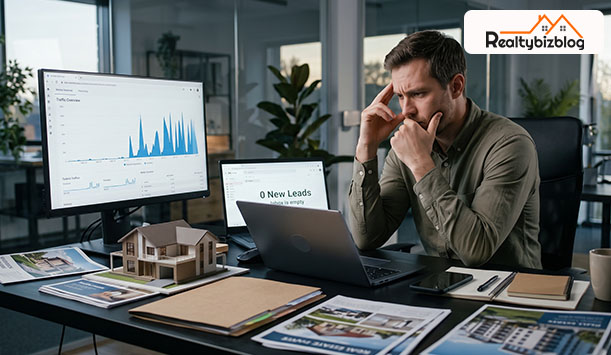
Accessing Google Analytics shows that visitors are on your real estate website. Some are reading your property page while some check out the blog while a few visit the home page and so on. Numbers appear to be looking good; therefore, you expect to get a few inquiries.
When you open your email, however, it is a different story, as you hardly find any inquiry.
You spend hours working on your websites by putting listings and writing blogs to attract clients’ attention but your efforts do not yield the expected results.
The problem here is sometimes not even the number of visitors but what happens after visiting a website.
People Visit, Look Around, And Leave
Imagine that a person is looking for homes with three bedrooms in your local area and finds your website, and looks through some of your listings and photos and leaves without contacting you.
Why does this happen?
Maybe they haven’t found enough information on the website. For instance, they can hardly find the property price or have not gotten a clear picture of the rooms. Sometimes, they may look for information about the neighborhood or schools nearby but are disappointed by the fact that all necessary details are absent in your listing.
Or maybe they were just not able to find a simple way of asking questions.
Not all website visitors will convert immediately into leads. Some may be at the beginning of their search, while others may be comparing houses on many websites. Nevertheless, if many visitors are leaving your website without any action, it is a good idea to find out if your website can provide them with a reason to stay.
Are You Attracting the Right Visitors?
Assume you are an estate agent in your city. Visitors can come to your website from across the nation due to your general content on buying houses. The result will be higher traffic figures; however, it might bring little attention to your business.
This is the reason why careful choice of keywords and themes for your content is very important in the current situation.
If you want to get traffic from people in your area who are interested in buying real estate, you need to create content about your areas and services offered in your area. You need to write about prices of real estate, what process should be followed when buying a property, renting etc.
Blogging still has a place in this process. A useful article can introduce someone to your business before they are ready to contact an agent. This is also why maintaining a helpful real estate agents blog can be worthwhile.
Make It Easy for People to Contact You
Have you ever gone to a site and spent far longer than you had to trying to look for the contact page when you could have been looking at your product? This is a lot more common than companies think.
It is important to make sure your contact details can easily be found. Include a visible enquiry button near property descriptions, ensure your phone number can be easily clicked on mobile devices, and make sure your enquiry forms are simple.
There is no point to asking for ten different pieces of information in order to find out whether someone is interested in a particular property or not. Start with what you need such as a name, contact information, and their enquiry.
It is also important to check what happens after someone fills out your form. Does your site confirm the enquiry? Does the enquiry reach the necessary email address?
Your Property Listings Need to Answer Real Questions
When someone writes a property listing, it has to be more than just pictures of the property with a short description.
Customers want to get an idea of what they would be getting before they make a move. They would want to know about the condition of the property, the availability of amenities, location, price, etc. Thus, give them as much info as you can.
For instance, writing “Beautiful family home located in a great place” doesn’t give much. Talking about how the home consists of three bedrooms, a living area, a parking, and access to shopping will let them know something more concrete.
Nice pictures are important as well. Blurred images, dark rooms, and pictures showing only the outside of the property will make the readers think that they are not interested in what you offer.
They do not have to be at luxury magazine standards but they must be truthful.
Can Guest Posting Help Bring in Better Leads?
Potential clients can find out about your business by using sources that are often overlooked. This includes posting relevant and valuable content on asset websites or local blogs that connect you to audiences that might never visit your site.
For instance, real estate guest posting allows an agent to share useful information with another site’s readers. Topics could range from mistakes that first-time buyers make and how a seller can prepare before listing properties to issues that must be considered before investing in rental homes.
You can also explore guest blogging for real estate agents as part of a broader content strategy. Well-written and informative articles published over time can enhance the agent’s reputation, provide them with referral traffic, and familiarize the audience with their services. However, keep in mind that guest posting can help if your site has good inquiry forms, and listings are up-to-date.
Check What Happens After the Click
Before redesigning your entire website, take a closer look at the numbers.
Google Analytics can help you understand which pages people visit, how they arrive at your website, and what they do next. Google Search Console can show which search queries bring people to your pages and how often those pages appear in search results.
Start by checking a few basic things:
- Which pages receive the most traffic?
- Which pages bring visitors who actually enquire?
- Are people leaving important service or property pages quickly?
- Do mobile visitors behave differently from desktop visitors?
- Are your enquiry forms working properly?
You may discover that your blog attracts plenty of visitors while your property pages receive very few enquiries. Or perhaps one service page gets good traffic but has no clear contact option.
That gives you something specific to fix instead of guessing what might be wrong.
Don’t Change Everything At Once
Whenever inquiries are dwindling, the first reaction could be to revamp the website, redo content of every page, and pump more money into advertising. However, there is no need for that.
Begin by modifying a relevant web page with decent traffic. Update its content, make the next steps clearer, and monitor whether there are changes in inquiries as time goes by.
If customers cannot see contact information, address this issue first. If they are being directed to outdated sites, fix that. If the search is coming from people outside your business area, check which keywords are bringing the traffic.
Allow enough time for your changes to take place before evaluating their efficacy.
Traffic Is Only Part of the Job
Bringing people to your real estate website is just one part of the puzzle. You want to ensure that the right visitors come, learn about your services, and take up relevant actions.
Having visitors on your website does not necessarily mean that they will fill out applications right away. There may be visitors today who will pay you a visit sometime in the future. Or there might be a visitor who will contact you immediately after being interested in one of your listings.
Your website should make both scenarios happen with ease.
So in case the website has seen an increase in visits but this has not resulted in a single inquiry, one should not think simply about attracting more visitors. It makes sense to analyze what pages users visit, what information users are looking for, and what your request is for them after visiting these pages. Sometimes, a few simple changes on the website may have a much bigger impact than trying to drive more traffic.