
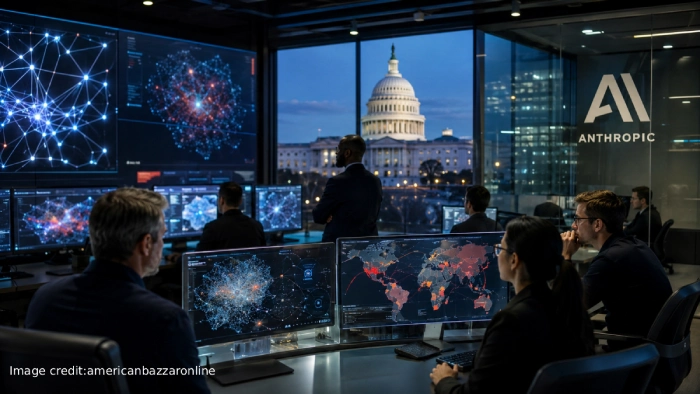
The United States government has reportedly ordered artificial intelligence company Anthropic to restrict foreign access to its most advanced AI models, marking a major escalation in global AI regulation and national security oversight.
According to reports from Reuters and Axios, the restriction applies to Anthropic’s high-end AI systems known as Fable 5 and Mythos 5. The move is said to be linked to concerns that advanced AI technologies could be exploited for cyberattacks, software vulnerability detection, or other national security threats.
Anthropic confirmed that it has temporarily disabled access to the models for users worldwide in order to comply with the directive issued by the US government. The company reportedly received instructions from the US Commerce Department regarding export control measures tied to advanced AI capabilities.
The restrictions signal a significant shift in how governments are approaching artificial intelligence. Until recently, export controls mainly focused on semiconductor chips and hardware used to train AI systems. However, the latest action suggests that AI models themselves are now being treated as strategic technologies that may require tighter international controls.
Reports indicate that the US administration is particularly concerned about the possibility of advanced AI models being “jailbroken” or manipulated to carry out harmful cyber activities. Security experts have increasingly warned that highly capable AI systems could assist in identifying vulnerabilities in critical infrastructure or automating sophisticated hacking operations.
Anthropic, which has positioned itself as an AI safety-focused company, reportedly disagreed with how the directive was implemented. The company stated that the government had provided limited evidence regarding the risks and that the decision disrupted commercial operations and access for legitimate users.
The development also highlights the growing tension between AI companies and regulators over balancing innovation, accessibility, and national security. Industry analysts believe the decision could influence future policies affecting other AI firms, including OpenAI, Google DeepMind, and xAI.
As governments worldwide race to establish AI regulations, the Anthropic case may become a defining moment in determining how advanced artificial intelligence technologies are controlled across borders.